
It sounds like tech futurism, the kind of statement you file away under "interesting but irrelevant." Except Google isn't waiting.
They're already rolling out the technology to make it happen. A2UI (Agent to UI) is already quietly running inside products like Opal and Gemini right now.
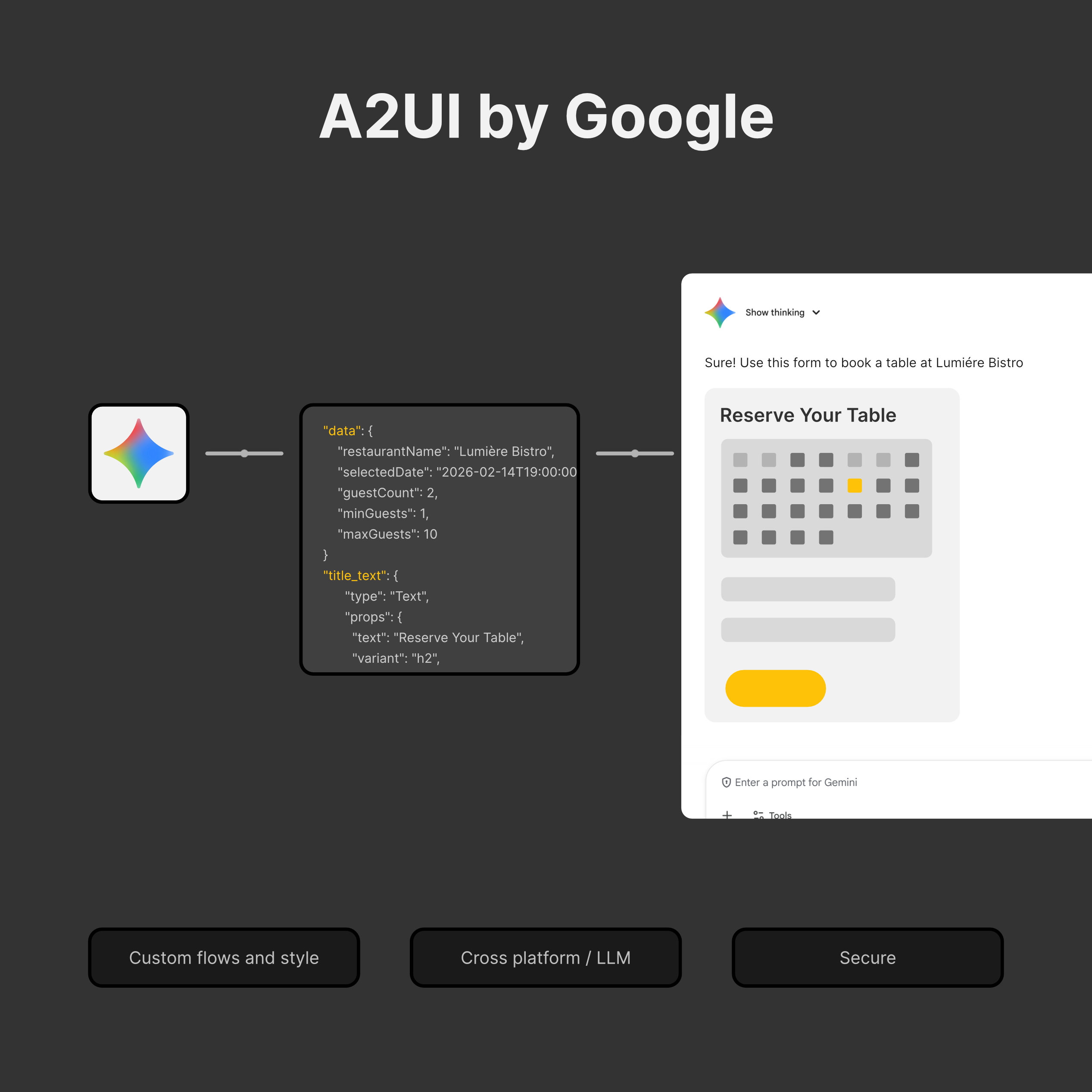
Instead of fixed screens and static layouts, A2UI lets AI agents generate complete user interfaces on the fly, personalized to each user's intent in real-time.
Here's why this matters if you care about brand visibility, SEO, or Answer Engine Optimization: in a world where interfaces are generated dynamically by AI agents, your brand doesn't just need to rank in search results or get cited.
It needs to be the answer the agent chooses to build an interface around. And when that is in place, how to get to know that it ever happened?
This isn't about optimizing for one more platform. This is about a fundamental shift in how users interact with information, and it's already live at v0.8 under an Apache 2.0 license.
The Protocol That Changes Everything
A2UI solves a problem most people haven't noticed yet: how do AI agents send rich, interactive interfaces across trust boundaries without executing arbitrary code?
The traditional answer has been text-only responses. Clean, safe, but limited. The other option is letting agents execute code in your app, which is a security nightmare.
A2UI takes a third path. Agents send declarative component descriptions, structured data that describes what the interface should look like and how it should behave. The client application then renders those descriptions using its own native components.
Think of it like this: instead of an agent saying "here's some JavaScript to run," it says "here's a form with three fields, a date picker, and a submit button." Your app renders that using your own styled components, in your own visual language, with your own security controls.
The agent describes. The client renders. The brand controls the visual identity.
Why Product Teams Should Care
The shift from fixed UIs to agent-driven interfaces changes the fundamental job of product teams.
Engineers define a vocabulary of components. AI agents compose those components dynamically based on user intent. A request like "book a table for 2 tomorrow at 7pm", "update a booking" or "cancel a booking" generates an in-chat form where both the user and the agent can fill in information, collapsing what used to be 3-4 navigation steps into a single contextual interface.
Designers stop focusing on screen layouts. Instead, they build flexible component libraries that agents can mix and match. Engineers build rendering pipelines, not bespoke UIs.
The interface adapts to the user's context, not the other way around.
The Strategic Implications for Brand Visibility
If interfaces are generated by AI agents, brand visibility becomes a function of which brands the agent chooses to feature in those interfaces.
A2UI enables external agents to send UI through your application while respecting your visual identity. An OpenTable agent can generate a restaurant booking form inside the conversationg. A CRM agent can compose a contact management interface. An expense tracking agent can build a receipt upload flow.
This creates what we're calling the "headless agent" business model:
The platforms that host these agents become more valuable when they have rich component catalogs. Third-party agents look native and polished because they're using the host app's own design system.
But there's a flip side: if your brand isn't represented in the agent's knowledge base, it won't be featured in the generated interfaces. This is where Answer Engine Optimization becomes critical.
AEO in an Agent-Driven Interface World
In a world of agent-driven interfaces, AI Influence becomes even more important. It's not just about whether the AI mentions your brand in a text response. It's about whether the AI chooses to build an interface around your brand.
Consider a user asking, "What's the best expense tracking tool for freelancers?" In a traditional answer engine, the AI generates a text response listing options. In an A2UI world, the AI might generate an interactive comparison table, a sign-up form, or even a pre-configured dashboard showcasing the top options.
The Dark Funnel Problem Nobody's Talking About
A2UI has not mentioned once that they will share usage statistics from these agent-driven flows.
Think about what this means. When an AI agent generates an interface featuring your brand inside someone else's application, you get zero visibility into:
This creates a massively expanded dark funnel. In traditional SEO, you at least got referral data when someone clicked through from a search result. In A2UI's agent-driven world, the entire discovery and consideration phase happens inside interfaces you can't track, built by agents you don't control, living inside applications you don't own.
You get little to no insight about what's happening until a lead lands in your CRM or a customer completes a transaction. Everything before that moment? A black box.
The problem compounds because these agent-generated interfaces feel native to the host application. Users don't realize they're interacting with content sourced from external agents. There's no clear attribution chain. No way to A/B test. No funnel metrics. No conversion path analysis.
For brands that have spent a decade building sophisticated attribution models and conversion tracking, this is a step backward into the dark ages of marketing analytics. You're back to "half my advertising budget is wasted, I just don't know which half," except now it's "half my brand mentions are driving intent, I just can't see where or how."
What This Means for You
If you're responsible for brand visibility, SEO, or Answer Engine Optimization, here's what A2UI changes:
For Content Strategists: A2UI is a protocol that uses data from a predefied service, meaning that updating your page content has no effect.
For Product Teams: Start thinking about if any of your current products have a typical flow, either it is sales or receiving requests. And check the A2UI documentation to check if this is something you should offer.
For Brand Managers: If you're not tracking your brand mentions and citation probability in AI answers, you're flying blind in the most important channel shift since mobile.
For Marketers: The "headless agent" business model creates new partnership opportunities. Your brand's specialized intelligence (booking, CRM, analytics) can be delivered through any partner's surface.
The Technical Reality: How A2UI Works
A2UI is now at v0.8, open-sourced under Apache 2.0 by Google with contributions from CopilotKit and the open-source community.
The protocol is designed to be LLM-friendly. It uses a flat, streaming JSON structure. Large language models can generate A2UI messages incrementally without needing perfect JSON in one shot. They can stream UI updates as they're generated, so users see the interface building in real-time.
The architecture is framework-agnostic. One agent response works across Angular, Flutter, React, or native mobile. You render the same UI description using your own styled components.
And it's secure by design. Agents can only use pre-approved components from your catalog. No UI injection attacks. No arbitrary code execution. The data format is declarative, not executable.
Google is already using this across experimental products. v0.8 is live. This isn't vaporware or a research paper. This is production-ready infrastructure for the next generation of AI-powered applications.
Conclusion
Traditional UIs aren't going away overnight. But Google's former CEO isn't wrong. The shift to agent-driven interfaces is already happening, and A2UI is the protocol making it possible.
For brands, the question isn't whether this will happen. It's whether you'll be featured when it does.